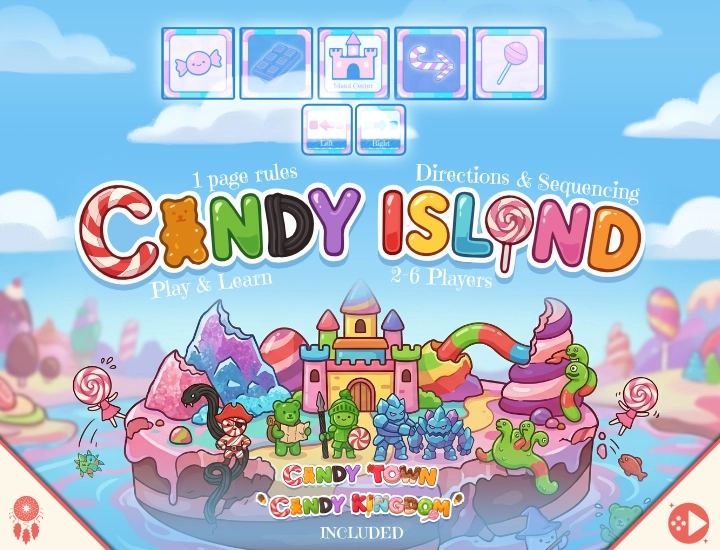
Description
Candy Island is an educational game that combines teaching about directions (left/right) with teaching about sequencing (first/last). It’s probably the most advanced game in this topic (“My First Comparing”) because of this. We recommend trying some of the other games first before trying this one.
All players are visiting the mysterious, legendary Candy Island! You’re having a fun time, grabbing a Candy tile each turn, only to realize … that the island is shrinking! With every tile taken from the end of the island (first/last tile), your pawn moves closer to falling off!
Be smart about the tiles you grab. Use the Candy powers wisely to flip the direction where the next player must grab a tile—and save yourself one more round.
The last player standing wins the game.
Come visit Candy Island, but don’t stray too close to the edge …
Player Elimination!?
This is the only Level 1 game which has player elimination: you can fall off the island and be out of the game. Player elimination is generally a bad idea in games, which is why we so rarely use it. But when it makes sense—such as in this game—it’s still a nice mechanic that leads to tense and fun games. Matches are so quick, and players have so many ways to save themselves, that players are generally only out of the game for a minute or two.
The rules do include a version without elimination if desired. We did not make this the default because it requires explaining a few more rules. And with young kids especially, fewer rules is always better!
The expansions also add a cooperative mode (you play together “against the island”), more Candy powers (some of which require some skill with counting), and more!
Printing Possibilities
We aim to make our games look colorful and appealing to your Apprentices. That’s why the rulebook and material is profesionally designed and full of color.
We also realize, however, that printing in color is not possible for everyone or can be expensive. That’s why we’ve added an alternative version of the material that is black and white. It also includes a reminder about what every tile does on the tile itself, because without color they can be harder to differentiate.
Let us know if you think such additions are valuable (or if you’ve used them). If so, we will try to provide alternative material PDFs more often.
Candy Town + Candy Kingdoms
UPDATE: The game now includes the expansions “Candy Town” and “Candy Kingdom” for free!
- Candy Town adds a second dimension with an up/down Sign. It teaches those directions as well. Now you have more ways to save yourself and get the candy you want … but also more places where you can fall off.
- Candy Kingdom adds a third dimension with an in front/behind Sign. It teaches those directions as well. Every position is a stack of tiles, instead of a single tile. It means it takes a bit longer for gaps to appear, but it also means it’s harder to get the candy you wanted. Remembering where everything was is crucial.
We decided to turn these games into a single package because it’s more efficient. Candy Town/Kingdom use the same material as Candy Island, they just add a few more rules and tiles on top.
It also provides a very nice step-by-step curriculum. You can start by playing Candy Island, which is only one dimensional and by far the simplest. Once players understand that, you can transition to Candy Town. Once players can handle that, you can move to Candy Kingdom, which tests many different skills in deep ways.
Details
- ✔️ Pay once, use forever, however.
- ✔️ No hidden costs or data tracking.
- ✔️ No sign-up required.
- ✔️ No difficult licenses or restrictions.
- ✔️ Instantly arrives in your inbox. (Check spam folder!)
- ✔️ Fun and effective!
Product Contents
- Rulebook PDF (1 front page, 1 page base game, 2 pages with variants/expansions)
- Rulebook PDF for Candy Town and Candy Kingdom (1 page each)
- Material PDF (1 page pawns, 3 pages tiles)
- Material PDF for Candy Town and Candy Kingdom (1 page total)
- Material PDF (alternates; black-and-white for cheaper printing + rules reminders printed on tiles)
- The raw assets (illustrations, layout file, etc) for you to view/edit. (As
.affiles, which you can open with the free Affinity software.)
Fine Details
| Detail | Value |
| Activity Structure | turn-based |
| Age | 3 |
| Categories | sequencing |
| Duration | 15 |
| Language | en |
| Level | 1 |
| Multiplayer Mode | competitive, cooperative |
| Player Count | 2, 3, 4, 5, 6 |
| Subject | mathematics |
| Textless | true |
Subject: Mathematics
The curriculum is split into six main subjects that align with your typical school subjects.
This resource is part of the Mathematics subject. Below is a summary:
This subject teaches Mathematics from first principles to calculus. Level 1 explores the basic skills needed before you do any counting or see any numbers (such as grouping and comparing objects). Level 2(+) can then introduce numbers, counting, addition, multiplication, and more.

Faction: Gamiverses
This resource is part of the Gamiverses Faction.
But that's just one way to teach and explore its topic(s)!
You can always move to a different Faction to find a more effective way to teach the same topic.
Played a quiz? Try a game! Played a game? Try an escape room! And so on.
For example,
Charm: Board Game
This product is part of the Board Game charm.
Visit its main page to learn more about what that means. Below is a summary:
Board Games are simply physical games (as opposed to video games). They could be played using cards, without a board, with players physically moving around, anything.
Our board games follow the rule that your first game should only require a single page of setup + rules. Most of them are cooperative multiplayer experiences.
Spell: My First Comparisons
This resource is part of the My First Comparisons topic (or "spell").
Earlier topics taught Apprentices to identify if things are the same or not. This topic takes the next step: HOW are they different? This also gently introduces the idea of sequencing: putting things in order based on … something.
This resource also covers other topics. To keep things simple, the curriculum always considers the first topic listed to be the most important.
Use the buttons below to navigate to the previous or next topic in the curriculum.