Description
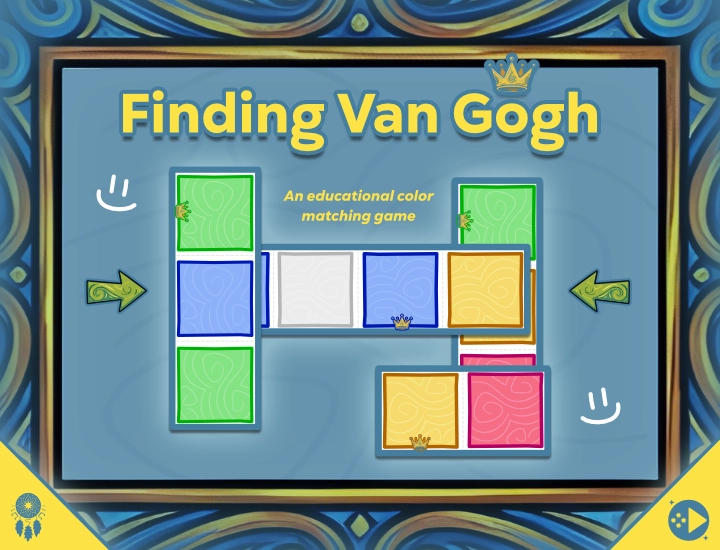
Finding Van Gogh is a simple color matching game. The base game is very simple and suitable for exploring / practicing colors with very young kids. Once you include the upgrades, the game becomes a family game that any group can enjoy and play over and over.
The game is simultaneous. Everyone picks their color card at the same time. This makes the game quick and means impatient kids don’t need to wait their turn.
The game is cooperative. You work together to complete the Secret Painting before the cards run out. (There is a competitive upgrade available.)
There are three little “tricks” that make this a game instead of just a puzzle or activity.
- If two players pick the same color, they are removed. (As such, you can’t play two of the same color in the same turn. Kids will need to discuss and collaborate to minimize wasting cards.)
- You can only add cards next to cards of the same color. This requires accurate color matching between the map, everyone’s hands, and the Secret Painting.
- But White is a wildcard: it can be any color. This requires “reverse thinking” about colors—a very powerful teaching tool—as now kids need to ask themselves “what color do I WANT it to be, so I can win?”
The game is simple. The rules for the base game easily fit onto a single page. It does require a Guardian (parent / teacher) being present to teach the rules and explain what each Secret Painting wants, but that’s true for all board games with kids so young.
The game requires little material. The base game only requires a few pages to print and cut out. The upgrades double that, but also give you five completely new ways to enjoy the game.
As usual, we’ve included a bit of information about Van Gogh, and added subtle hints to his painting style throughout the design. As opposed to most of our other games, though, this game is very tightly focused on exploring color and does not require any other skills or explore any other topics in doing so.
Have fun and keep learning!
Details
- ✔️ Pay once, use forever, however.
- ✔️ No hidden costs or data tracking.
- ✔️ No sign-up required.
- ✔️ No difficult licenses or restrictions.
- ✔️ Instantly arrives in your inbox. (Check spam folder!)
- ✔️ Fun and effective!
Product Contents
- Rulebook PDF (1 front page with information and story, 1 page base game, 3 pages with upgrades)
- Material PDF (3 pages for base game, 8 pages for upgrades)
- The raw assets (illustrations, layout file, etc) for you to view/edit. (As
.affiles, which you can open with the free Affinity software.)
Fine Details
| Detail | Value |
| Activity Structure | simultaneous |
| Age | 3 |
| Color | true |
| Duration | 15 |
| Language | en |
| Level | 1 |
| Multiplayer Mode | cooperative, competitive |
| Player Count | 1, 2, 3, 4, 5, 6, 7, 8 |
| Subject | mathematics |
| Textless | true |
Subject: Mathematics
The curriculum is split into six main subjects that align with your typical school subjects.
This resource is part of the Mathematics subject. Below is a summary:
This subject teaches Mathematics from first principles to calculus. Level 1 explores the basic skills needed before you do any counting or see any numbers (such as grouping and comparing objects). Level 2(+) can then introduce numbers, counting, addition, multiplication, and more.
Faction: Gamiverses
This resource is part of the Gamiverses Faction.
But that's just one way to teach and explore its topic(s)!
You can always move to a different Faction to find a more effective way to teach the same topic.
Played a quiz? Try a game! Played a game? Try an escape room! And so on.
For example,
Charm: Board Game
This product is part of the Board Game charm.
Visit its main page to learn more about what that means. Below is a summary:
Board Games are simply physical games (as opposed to video games). They could be played using cards, without a board, with players physically moving around, anything.
Our board games follow the rule that your first game should only require a single page of setup + rules. Most of them are cooperative multiplayer experiences.
Spell: My First Colors
This resource is part of the My First Colors topic (or "spell").
To learn mathematics, you need to be able to identify, compare, and group things. Colors are the easiest way to do this, because they’re visual and all around you. Teaching about colors allows Apprentices to play games or do puzzles, as well as unlock their creativity by drawing.
Use the buttons below to navigate to the previous or next topic in the curriculum.
External Enchantments
We try to share the love and improve education, not be greedy goblins. That's why we share source files and link related work of others when possible. Check out the list below of what went into this project or what inspired it. If possible, support those people too!
| Link | Explanation |
| Mondrian: Color in Motion | This game clearly inspired ours. It’s obviously very good, and we recommend it, but it uses some more material and rules (pawns, counting, etc). We wanted to simplify it, make it more accessible to young kids learning about colors, and use our upgrades to clearly steer it into educational territories. |